

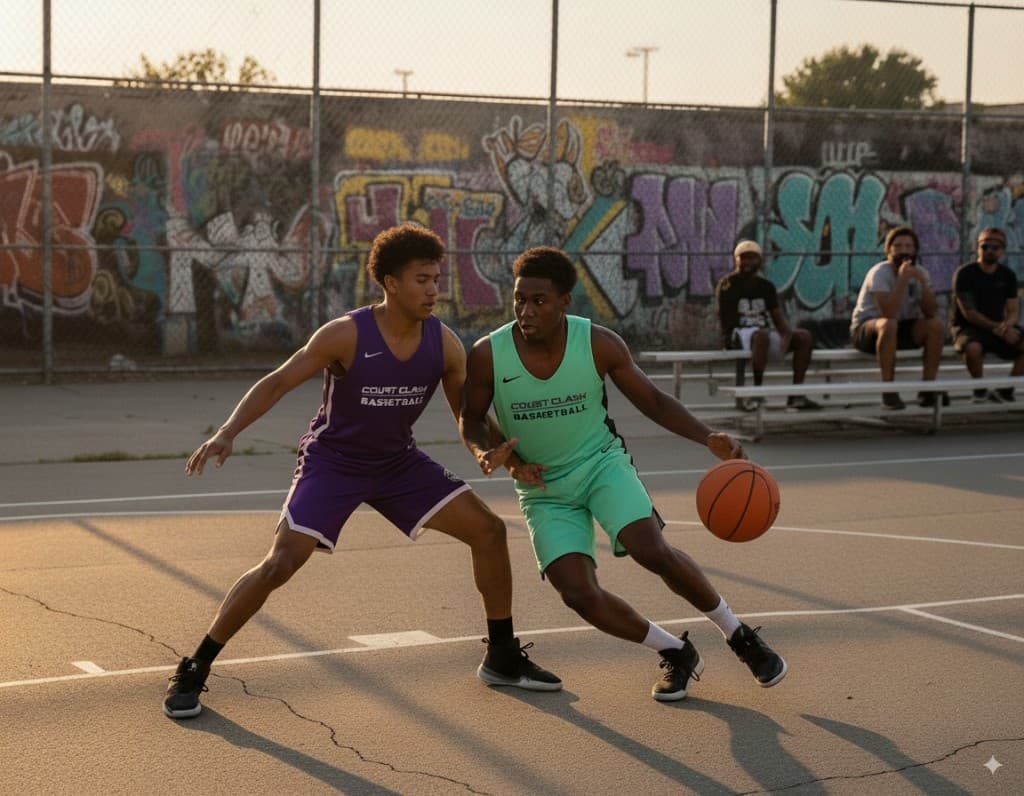
Eli, 24 — King of the asphalt. On the court at square de la Guillotière in Lyon, the asphalt is cracked, the lines barely visible. But for Eli, 24, it's a sanctuary. "Here, it's more than a court. It's my school, my ring, my stage." Every evening at dusk, when the orange streetlights come on and sneakers squeak on the pavement, Eli comes to take on anyone who dares wait for him.
A kid from the neighbourhood — Eli grew up a few streets away, in a tower block where basketball was often the only way to channel the kids' energy. His father worked nights, his mother did cleaning. He spent his afternoons on the court, a worn ball in his hand. "I was twelve and I got crushed by the older guys. I lost a hundred times, maybe a thousand. But by keeping coming back, they ended up respecting me." He never played for a club — too expensive, too many rules, too much bench. "I always preferred the street. Here it's pure. If you've got game, they tell you. If you don't, you're out." Soon Eli became "the kid with the killer crossover". The old heads call him Kid Eli. The nickname stuck.
1v1 as identity — At 16 he realises that 1v1 is more than a format: it's a philosophy. "It's you, your ball and your mind. If you're afraid to lose, you've already lost." Every duel is a fight — against an opponent, but above all against yourself. Eli plays every night. Sometimes in the rain, sometimes alone, sometimes injured. His game becomes explosive, instinctive, almost poetic. "1v1 is the mirror of life. No one's got your back. You take hits, you fall, but you have to get up. Always."
Social media and the asphalt's revenge — In 2021, during lockdown, Eli is bored. Tournaments are cancelled, gyms closed. So he decides to film his street games. A tripod, an iPhone and an old friend to commentate the duels. The first video gets 300 views. The second, 2,000. Then it takes off. People love his style: lightning crossovers, James Harden step-backs, and a quiet warrior attitude. Messages pour in: "Come challenge me in Marseille!" "You're the real boss of the asphalt!" Eli becomes, without meaning to, a small celebrity of urban basketball. But he keeps a cool head: "Views are fine. But on the court there are no likes. Just the score."
Discovering Court Clash — One day a friend tells him about a brand-new app: Court Clash. "He said: 'It's like a street ranking. You play, you score, you climb.' I downloaded it straight away." Eli discovers he's not alone: players all over France are going head-to-head, recording games, climbing the rankings. "What I liked was that it makes 1v1 official. You play on the street but you have a real record of your performance." He quickly climbs the regional rankings. His profile gets attention, his videos blow up even more. But above all he finds the motivation to push himself. "Before I only played for myself. Now I play to represent my city."
A mentality forged on the asphalt — Eli hasn't had an easy path. A knee injury at 19 kept him off the court for over a year. "I had nothing left. No game, no energy. I even thought about quitting." But basketball brought him back. "One day I walked past the court. There was a kid playing alone. I picked up the ball, just to try. I felt alive again." He hasn't stopped since. Every game is for him a revenge on everything that could have broken him. "When I play I forget everything. The struggles, the doubts. It's me and the sound of the ball. Nothing else."
From street player to mentor — Today Eli works as a sports educator in his neighbourhood. He runs initiation sessions for young players, teaches them the basics of 1v1 and above all the mindset. "I want them to understand that basketball isn't just a sport. It's a way to build yourself." He uses Court Clash to motivate them, set goals, show their progress. "When they see their ranking go up, their eyes light up. That's what makes me proud." He dreams of creating a national Court Clash tournament where the best from the playgrounds would defend their title, city against city. "That would be the ultimate: the street reclaiming its place, with its rules, its heroes and its respect."
A local legend, a global symbol — Eli didn't make it as a pro. He doesn't boast about it, but he doesn't hide it either. Because he found something else: genuine recognition from the people on the court. When he walks through the square, kids call him "Coach Eli". The older ones give him dap. He doesn't need more. "I may not have the NBA, but I have the street. And here, I'm home." On Court Clash his profile shows over 80 recorded duels, a streak of 14 consecutive wins and challenges from all over France. But beyond the numbers, Eli embodies something essential: proof that urban basketball can be a path, an identity, a story.
Eli is that player you run into on a summer evening, shirtless, focused, ready to defend his spot. The sound of the ball echoes on the asphalt, laughter rings out, the sun goes down. And in that suspended moment you understand why street basketball will never die. Because for some, it's much more than a game — it's a way of existing.