

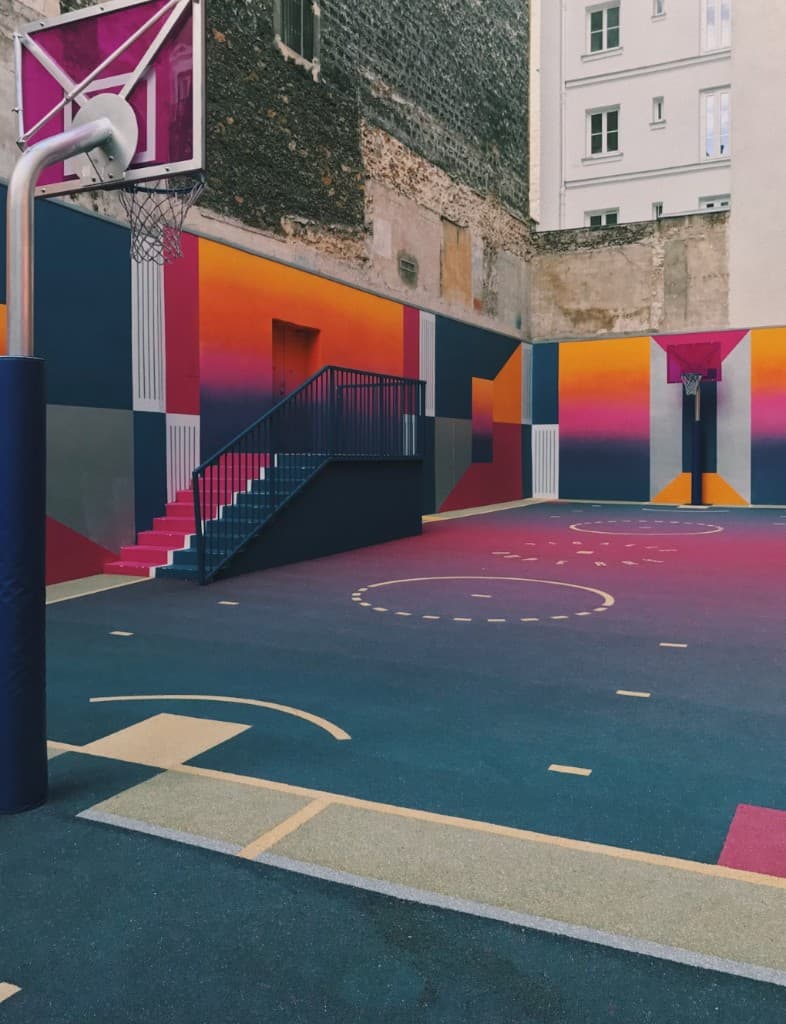
From the playground to a global cultural phenomenon.
The origins: street basketball first — Basketball was born in 1891 in a gym in Springfield, Massachusetts, invented by James Naismith. But it quickly escaped the school walls to find a new playing field: the streets. In the 1940s and 1950s, in New York, Chicago or Philadelphia, children in working-class neighbourhoods put up hoops on walls, cobbled together courts, and gave the game another dimension: freer, more physical, more creative. The playground became a social, cultural and identity space. You didn't just play to win: you played to show your style, make your name and earn the respect of the neighbourhood.
Legendary playgrounds: cradles of the myth — Harlem, Rucker Park, The Cage, Dyckman Park… These names echo like legends. These courts became real arenas of urban basketball, where the best faced off in front of hundreds of spectators packed around the asphalt. Players like Julius Erving (Dr. J), Kareem Abdul-Jabbar, or later Kevin Durant, all walked these courts before shining in the NBA. At Rucker, you came as much to play as to show your personality, with flamboyant style, spectacular moves and nicknames that became legendary: Skip to My Lou, Half Man Half Amazing, The Professor… Streetball became living entertainment, a mix of sport, music and hip-hop culture.
The 90s: streetball enters pop culture — In the 1990s, urban basketball exploded with the rise of hip-hop culture. Baggy clothes, mixtapes, slang, everything influenced everything else. Playgrounds became performance stages: every dribble told a story, every move became a signature. The arrival of the famous AND1 Mixtape Tours was a turning point. These streetball tours criss-crossed the United States, then the world, stringing together crazy moves, humiliating crossovers and spectacular dunks. For the first time, streetball became a globally broadcast show, inspiring an entire generation.
The international rise of street basketball — In the early 2000s, urban basketball culture spread to Europe, Africa and Asia. Tournaments like Quai 54 in Paris became must-see events, blending music, sport and style. Brands took notice, the media followed, and the street became a lab for basketball innovation. New rules and formats were tested — including 1v1 and 3×3, which would eventually be officially recognised by FIBA. Urban basketball stopped being a subculture: it became a full pillar of world basketball.
1v1: the duel in its purest form — At the heart of urban basketball there has always been the duel. 1v1 is the DNA of the game: no coach, no teammates, no excuses. That's where you see a player's truth — their mentality, technique and creativity. On the playgrounds, 1v1 has always been a rite of passage: win your duel and you stay on the court; lose and you're out. Today, the format is enjoying a spectacular comeback, driven by social media, independent tournaments and new digital platforms.
CourtClash: when the street meets digital — It's in this context that CourtClash emerged, a French app that aims to connect the new generation of 1v1 players. The idea: let everyone find an opponent, set up a game, record the score and track their ranking. CourtClash doesn't just digitise the game — it gives it back a community and competitive dimension true to the spirit of the playgrounds. It's where asphalt culture meets mobile tech. Where the old school made Rucker Park shake, the new generation is writing its legend… on CourtClash.
A culture that never dies — Urban basketball isn't just a style of play, it's a mindset: freedom, creativity, confrontation. It has given birth to legends, cultural movements and sporting innovations that have transformed world basketball. Today it still inspires young players across the globe, from the Bronx to Marseille, Paris to Tokyo. The asphalt stays sacred. And as long as there's a hoop, a ball and two players ready to battle, the spirit of streetball will live on.